
NASCAR Senior Vice President of Strategy and Innovation Ben Kennedy talks about the sport during an interview at NASCAR Headquarters in Daytona Beach, Tuesday, Feb.15, 2022. Daytona Kennedy03
NASCAR Senior Vice President of Strategy and Innovation Ben Kennedy talks about the sport during an interview at NASCAR Headquarters in Daytona Beach, Tuesday, Feb.15, 2022. Daytona Kennedy03
NASCAR’s street-race experiments have finally evolved beyond just risks at new tracks designed to get American audiences to tune in. They have now instead become a test of how far the France family can stretch the sport’s identity.
The play that the ideologues at NASCAR are making is now pretty apparent. They seem to be studying iconic venues and international markets in an attempt to build NASCAR its own global marquee event.
And these niche events also seem to be beginning to deliver results.
“I would say in general, events like this they’re important for a lot of new fans that come into this sport,” NASCAR's Chief Operating Officer Ben Kennedy told Sports Business Journal.
“They bring in more partners. Outside Daytona 500, the Chicago and San Diego street races sell quicker than anything else that they see on the schedule.”
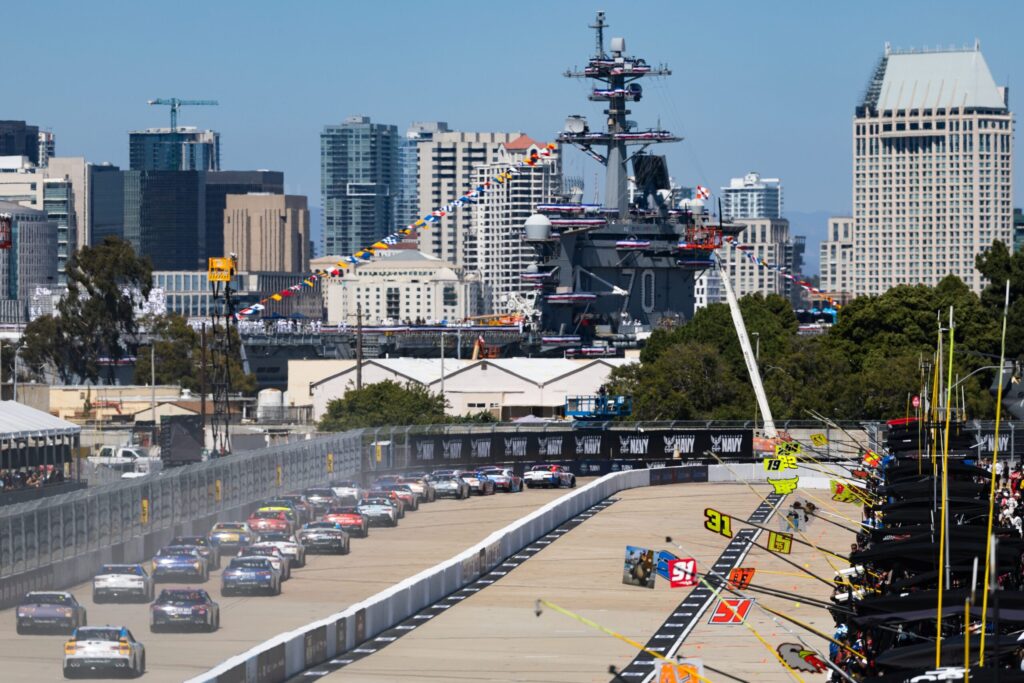
Jun 20, 2026; San Diego, California, USA; Cars drive during the NASCAR O'Reilly Auto Parts Series United Rentals Driven to Serve 250 at Naval Base Coronado. Mandatory Credit: Karl Anderson-Imagn Images
Jun 20, 2026; San Diego, California, USA; Cars drive during the NASCAR O'Reilly Auto Parts Series United Rentals Driven to Serve 250 at Naval Base Coronado. Mandatory Credit: Karl Anderson-Imagn Images
Kennedy said the concept also stretches beyond the U.S. “There’s such a strong automotive community that’s outside the United States, whether it’s in Brazil or in Europe.”
Then came the sign we had all been waiting for, with indications of NASCAR’s expansive future. “You think about the Monacos of the world, those are iconic events. And we wanted to create our own version of that that’s authentic to us,” Kennedy added.
He went on to point out that landmark venues in the States were already being considered. “We’ve talked about Central Park before,” Kennedy said. “Central Park would be epic.”
On Kennedy’s point about the continuation and expansion of such niche NASCAR races, substantial data support his claims. For instance, the recent race in San Diego stands as a perfect example. Let’s find out how.
How street courses are rebuilding NASCAR’s audience
As of June this season, NASCAR’s San Diego race offered the clearest evidence yet of why non-traditional venues seem to be working out for NASCAR.
It was reported by SBJ in the same source that the venue sold roughly 50,000 seats, with 67% of buyers attending their first NASCAR event, fans coming from all 50 states and 17 countries, and nearly 40% of ticket buyers being female.
Not only that, but the Hispanic turnout was nearly three times that of a regular NASCAR event.
This is the exact backing to Kennedy’s claims regarding “a lot of new fans” turning up. This measurable change is exactly what the marketing heads at NASCAR have been struggling to attract.
And if such results continue, then without disagreement, NASCAR’s new landmark venue strategy seems to be working.
You can read more on the Daytona Racing Digest!
Written by

Uday Jakhar
Edited by

Suyashdeep Sason