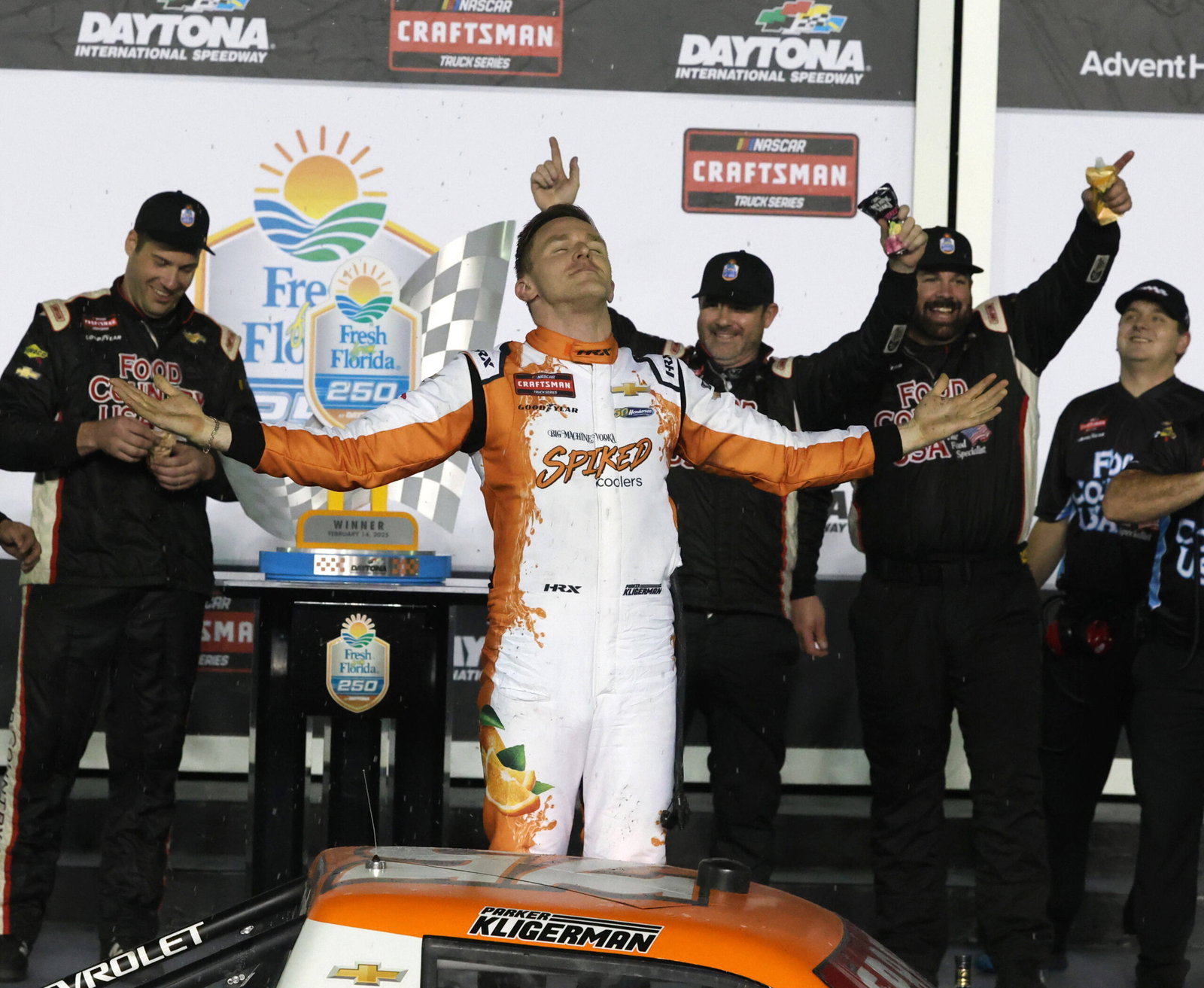
DAYTONA BEACH, FL - FEBRUARY 14: Parker Kligerman 75 Henderson Motorsports Spiked Coolers Chevrolet celebrates winning the NASCAR, Motorsport, USA Craftsman Truck Series Fresh From Florida 250 on February 14, 2025, at Daytona International Speedway in Daytona Beach, FL. Photo by Michael Bush/Icon Sportswire AUTO: FEB 14 NASCAR Craftsman Truck Series Fresh From Florida 250 EDITORIAL USE ONLY Icon250214042
DAYTONA BEACH, FL - FEBRUARY 14: Parker Kligerman 75 Henderson Motorsports Spiked Coolers Chevrolet celebrates winning the NASCAR, Motorsport, USA Craftsman Truck Series Fresh From Florida 250 on February 14, 2025, at Daytona International Speedway in Daytona Beach, FL. Photo by Michael Bush/Icon Sportswire AUTO: FEB 14 NASCAR Craftsman Truck Series Fresh From Florida 250 EDITORIAL USE ONLY Icon250214042
The result at the finish would merely show P11 at Texas Motor Speedway, but in no way would it truly capture the story behind Parker Kligerman’s return in a RAM entry.
Kligerman drove Kaulig Racing’s No. 25 Ram 1500 at Texas, a track where he had begun his journey 16 years ago. “I actually made my very first NASCAR Truck Series start in a Ram at Texas back in 2010, so returning here as part of the Ram factory team 16 years later is incredibly special."
“It feels like a full circle moment, very flattering and cool.”
In a race where many technicals mattered, Kligerman and the No. 25 operated way beyond their usual pace, converting what he described as a “15th place truck on speed” into a near top-10 finish.
The late-race drop, however, ultimately reflected the truth of his entry, which was, after all, an overachievement for a returning manufacturer effort still defining its competitive baseline.
“Yeah, I mean, you know, first and foremost thank you everyone at Ram for the opportunity. It was really cool to get to do this,” Kligerman expressed as he added. “Not every day you get a call from a factory race team, so that is very flattering. I was excited to be here.”
Commenting on his execution, he stated, “We were maybe a 15th place truck on speed, but we were executing at a level to get us to the top 10. We just missed out on it by one spot.”
Narrowing down on the matter, Kligerman commented, “We came down and put tires, those 20 lap scuffs, they turned out to be corded. That was why we dropped like a rock.”
He, however, zeroed in on his target, stating, “If we don’t have that issue, we get a top 10, which was the goal.”
Yet even in an excellent race finish, Kligerman didn’t forget the bigger picture. “I never really thought I’d be driving a Dodge Ram again.” He pauses on the past. “I was the last development driver and they left.” Which is why this matters to the young driver. “To come back with them at Texas, the first place I ever raced a truck with them, that’s super cool,” he added.
These nostalgic memories by the driver are reminiscent of a past when RAM was extremely relevant around the circuit, as he put it himself. But what changed?
Why RAM vanished and the structural reset fueling its return
RAM’s NASCAR exit was prompted by severe structural issues. The brand lost factory support after 2012, when Stellantis (then Chrysler/Fiat) restructured its motorsports priorities and key partner teams exited, removing the funding pipeline required to sustain OEM competition.
Even though independent teams continued briefly, without factory backing, it led to development being stalled, leading to the inevitable 2016 collapse, where RAM was effectively obsolete as body rules evolved, and no new updates were funded.
Their comeback this year is powered by a different logic, in an attempt to limit the aforementioned dependency failure. RAM re-enters as a factory-backed manufacturer for the first time since 2012, anchoring with Kaulig Racing and scaling immediately to five trucks, signaling full operational commitment rather than partial re-entry.
Central to this is the No. 25 Free Agent Program, a rotating seat with drivers not racing for a championship but benchmarking performance, allowing drivers to cycle weekly, generating diverse structural feedback necessary for the newly formed team.
This, in turn, would allow RAM to replace its earlier fragile structure with a scalable, feedback-driven model that could possibly make this new team remember its shining past.
You can read more on the Daytona Racing Digest!
Written by

Uday Jakhar
Edited by

Suyashdeep Sason