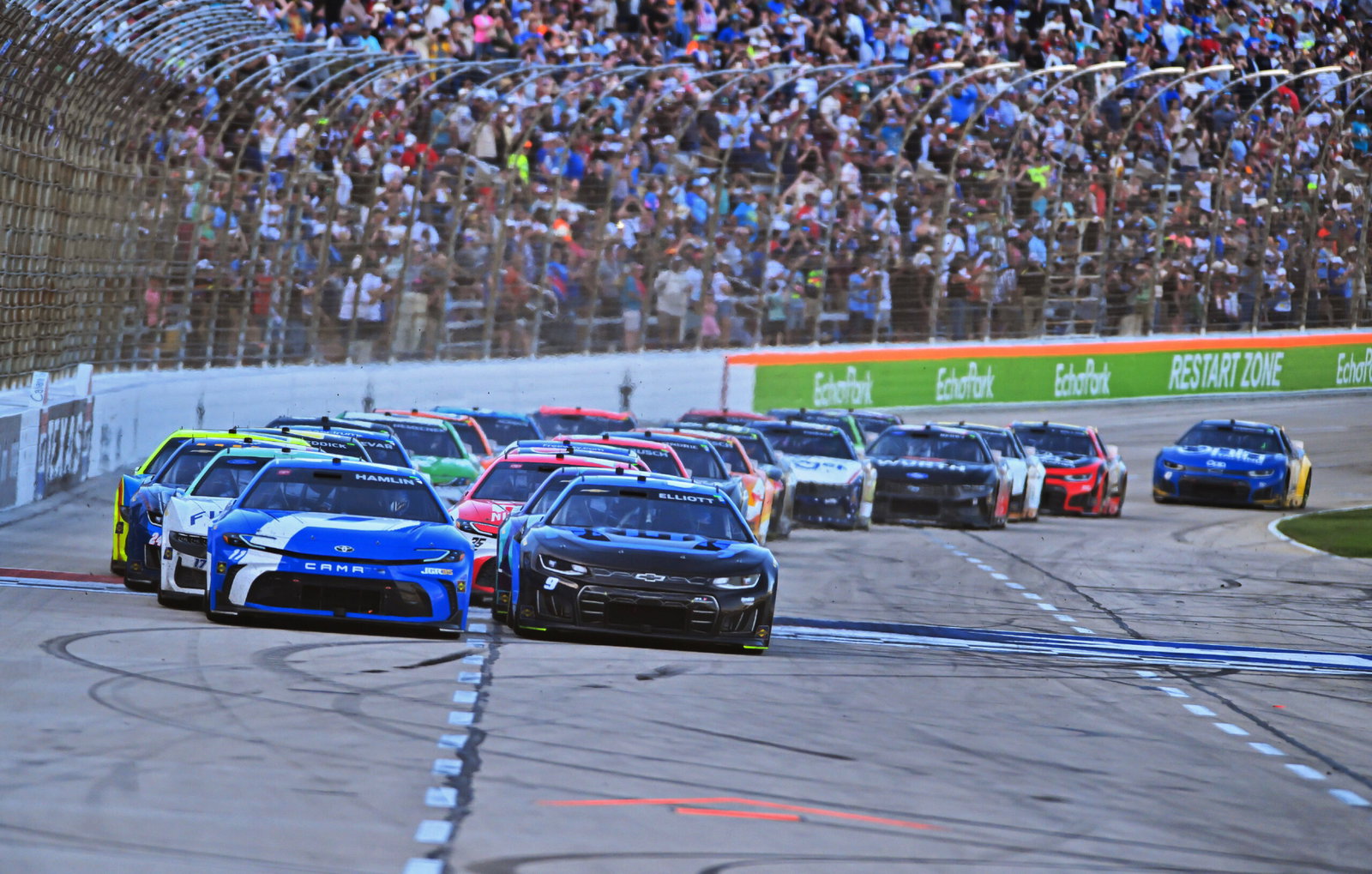
FORT WORTH, TX - MAY 03: Chase Elliott 9 Hendrick Motorsports Amazon Prime Chevrolet, right and Denny Hamlin 11 Joe Gibbs Racing Progressive Insurance Toyota, left lead a pack of cars down the front straightaway during NASCAR, Motorsport, USA Cup Series Wurth 400 on May 3, 2026, at the Texas Motor Speedway in Fort Worth, TX. Photo by Austin McAfee/Icon Sportswire AUTO: MAY 03 NASCAR Cup Series Wurth 400 EDITORIAL USE ONLY Icon260503008
FORT WORTH, TX - MAY 03: Chase Elliott 9 Hendrick Motorsports Amazon Prime Chevrolet, right and Denny Hamlin 11 Joe Gibbs Racing Progressive Insurance Toyota, left lead a pack of cars down the front straightaway during NASCAR, Motorsport, USA Cup Series Wurth 400 on May 3, 2026, at the Texas Motor Speedway in Fort Worth, TX. Photo by Austin McAfee/Icon Sportswire AUTO: MAY 03 NASCAR Cup Series Wurth 400 EDITORIAL USE ONLY Icon260503008
Every time the conversation moves towards the valuation of NASCAR charters, the figure that is always spoken of is often an estimated $100 million.
While that number has become a constant in the conversation, RFK Racing’s president, Chip Bowers, has just busted open what reality is and what is a myth. RFK Racing is currently in the hunt for a third charter for their 60 car going into 2027 and remains the team with the keenest eyes around charters.
Bowers was on the Stacking Pennies podcast and was asked by the hosts about the $100 million valuation going around. Bowers quickly dismissed it and said that’s not the true value and broke it down mathematically.
On the podcast, Bowers first cleared up the value of the charter according to the most recent one sold. “The value of the charter is higher than it’s ever been. And it’s much more valuable with the premier charter. What does that mean? I don’t think anybody knows yet.”
Bowers added, “The charter was sold at $46-48 million to Jimmie from Rick Ware Racing. That was the last one sold. So that’s the floor; that’s the market. Now the business model has to reflect the price of the charter.”
While he agreed that it was on the up, Bowers did the math and broke down how a 100 million valuation is a ballooned sum. The example he cited assumed a standard financing model with 20% down; an owner would be saddled with an $80 million note.
At a 6% interest rate, that equals $4.8 million in annual interest expenses before a car even turns a wheel on the track. When those figures are coupled with the high operational costs—hiring crew, engineers, and securing infrastructure—the deficit widens rapidly.
Even with sponsorship revenue, Bowers calculates a new one-car team would still operate roughly $7 million in the red each season.
Bowers believes breaking even isn’t worth entering NASCAR
Bowers spoke about how RFK Racing isn’t planning on slowing down in its hunt to become a premier team in the Cup series, and he also said that they are currently the best poised to take up a charter from NASCAR should one open up.
On the same Stacking Pennies podcast, Bowers pointed out that NASCAR would likely make additional charters available if a 4th OEM comes into the picture or new teams want to enter the Cup series.
While Bowers calculated that a single car team would end up losing approximately $35 million for 5 years, to simply break even, the team would have to attempt to sell itself for the estimated charter value of $100 million plus the $35 million loss to start their sale at an estimated $135 million.
Bowers applied that same math to a three-car team and said, “If I got two other charters, well, one’s not worth more than the other, so they’re all worth $135 million. That's $405 million for three charters, plus you add the building, plus all the staff. Let’s say another $20 million conservatively.”
The RFK boss added, “You’re at $425 million. That’s a big nut for someone to take on five years from now to buy into NASCAR… My concern is that it actually might prohibit people from getting into the sport.”
Bower suggests that instead of chasing inflated metrics, a grounded, stair-step approach to growth is more feasible.
By building a business model that emphasizes long-term value over quick-flip exit strategies, the sport can remain competitive without pricing out the very talent it needs to thrive.
You can read more on the Daytona Racing Digest!
Written by

Debrup Chaudhuri
Edited by

Suyashdeep Sason