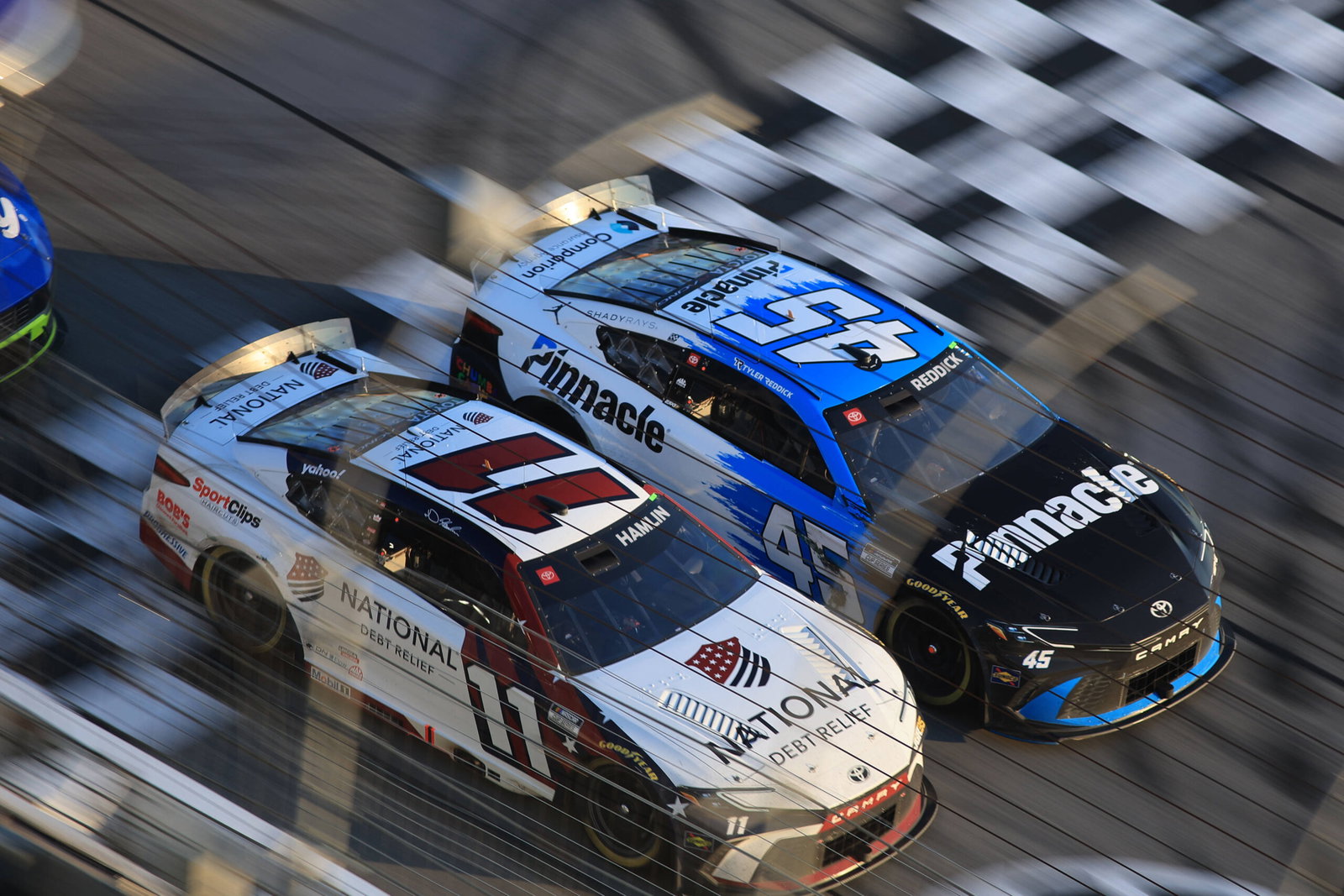
ATLANTA, GA - FEBRUARY 22: Denny Hamlin 11 Joe Gibbs Racing National Debt Relief Toyota races with Tyler Reddick 45 23XI Racing Pinnacle Toyota during the running of the NASCAR, Motorsport, USA Cup Series Autotrader 400 on February 22, 2026 at EchoPark Speedway in Hampton, GA. Photo by Jeff Robinson/Icon Sportswire AUTO: FEB 22 NASCAR Cup Series Autotrader 400 EDITORIAL USE ONLY Icon2602229807400
ATLANTA, GA - FEBRUARY 22: Denny Hamlin 11 Joe Gibbs Racing National Debt Relief Toyota races with Tyler Reddick 45 23XI Racing Pinnacle Toyota during the running of the NASCAR, Motorsport, USA Cup Series Autotrader 400 on February 22, 2026 at EchoPark Speedway in Hampton, GA. Photo by Jeff Robinson/Icon Sportswire AUTO: FEB 22 NASCAR Cup Series Autotrader 400 EDITORIAL USE ONLY Icon2602229807400
Toyota’s dominance in the ongoing Cup season has highlighted a very obvious performance gap between the three manufacturers. Many feel NASCAR should probably intervene and level the playing field, something that was discussed on the Door Bumper Clear podcast.
Filling in for Karsyn Elledge, Eric Brennan posed the question, asking if regulatory intervention is necessary to address the Japanese automaker’s dominance, after Chicagoland’s results, where seven cars to finish in the Top 10 were Toyotas.
“The questions were posed towards Ward (Burton), like when you used to work on the Cup cars together, and a rule change would come down for a manufacturer to take off some spoiler or kick out the nose. It seems like now, maybe because of Toyota's massive success, there are thoughts that maybe something needs to change or something needs to be done,” Brennan said.
Jeb Burton, who was one of the guests present on the podcast alongside his father, Ward Burton, noted that Toyota is willing to pour significant financial and intellectual resources into its racing program. He also argued that Toyota cannot be penalized for more effective investments in terms of engineering and ensuring that its cars go faster.
“But I just feel like Toyota sometimes doesn't have a budget. If you're getting to do those things, you cannot penalize those guys because they've gone to work and made their stuff really fast, right? They've got to catch up. Chevrolet and Ford will catch up. It goes in waves. They always have. Don't you agree?”
This prompted co-host Tommy Baldwin to chime in, saying that successful racing is driven by the expertise of crew chiefs, engineers, and mechanics who interpret data and make real-world setup decisions. He particularly cited the example of Slugger Labbe, Todd Berrier, and Wally Brown.
The ultimate consensus was that NASCAR does not need to "level the playing field" via new rules. Instead, all members on the podcast agreed that struggling teams should focus on their internal operational improvements, resource allocation, and collaborative structures, mirroring the integrated systems that Toyota has built through Joe Gibbs Racing and 23XI Racing.
That last bit was something Brad Keselowski had also highlighted in the eero 400 pre-race press conference, and he had agreed that Toyota operates on a superior level when it came to data-sharing and other resources between teams.
Are Toyota teams secretly running on more powerful engines?
In the same episode of the podcast, Tommy Baldwin pushed back against this theory. He stated that all three manufacturers were within 1% of the NASCAR limit. He also explained that while the engine power is tightly regulated, success often depends on proper planning and engine usage throughout the season, which can create performance disparities.
“I mean, look, you got the best of the best in all three manufacturers. I mean, you're going to have good engines. It's all again, you know, we have an engine, we have only a certain amount of engines that we run during the year, right? They get sealed, and you have to rerun these engines, I think, three times now.
"So, again, it's all about when you decide to put a fresh one in, right? That you might be running up against somebody that has three races, you know, it's its third race versus the first race, right? So, you might see a little bit different from that, but again, it's all about proper planning.”
When asked if Toyota engines were the best in terms of horsepower, he simply disagreed, saying, “No, I don't think so”, adding that dyno numbers don't always tell the whole story.
Read more at Daytona Racing Digest
Written by

Aaradhya Singh
Edited by

Suyashdeep Sason