
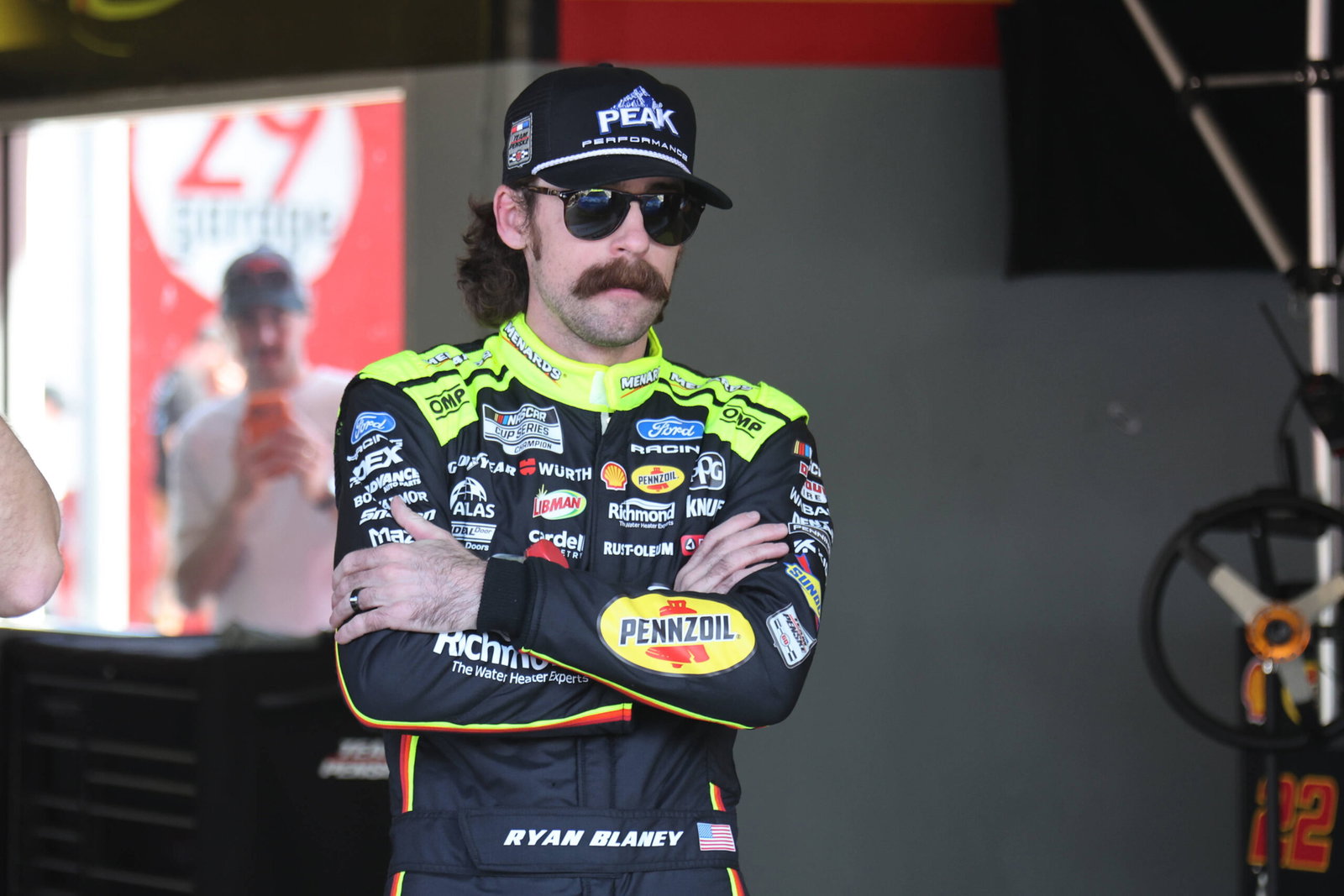
DAYTONA BEACH, FL - FEBRUARY 14: Ryan Blaney 12 Team Penske Menards/Peak Ford looks out in the garage area prior to the final practice for the NASCAR, Motorsport, USA Cup Series Daytona 500 on February 14, 2026 at Daytona International Speedway in Daytona Beach, FL. Photo by Jeff Robinson/Icon Sportswire AUTO: FEB 14 NASCAR Cup Series Daytona 500 EDITORIAL USE ONLY Icon2602142250500
DAYTONA BEACH, FL - FEBRUARY 14: Ryan Blaney 12 Team Penske Menards/Peak Ford looks out in the garage area prior to the final practice for the NASCAR, Motorsport, USA Cup Series Daytona 500 on February 14, 2026 at Daytona International Speedway in Daytona Beach, FL. Photo by Jeff Robinson/Icon Sportswire AUTO: FEB 14 NASCAR Cup Series Daytona 500 EDITORIAL USE ONLY Icon2602142250500
Ryan Blaney was exhausted after finishing 6th in Sonoma on June 28. Once the race ended, he was immediately taken to the care center to treat dehydration caused by his cool suit failing. This wasn’t the first instance of a driver's cool suit failing.
Several drivers suffered from the same issue in COTA, including AJ Allmendinger, who was stretchered off to get immediate treatment. A recent article by Motorsport.com writer Bozi Tatarevic shed light on why the cool suit keeps failing, especially in NASCAR.
“A cool suit system typically consists of a small box that is a miniaturized air conditioning unit which has an input and output for a hose that runs over the chillers,” Tatarevic wrote on March 3. "If a cool suit system fails, it will often result in the chiller part of the unit stopping to function and at that point the liquid will just continue to increase in temperature. At that point, drivers are typically in a worse situation than not wearing one of the shirts at all because they now have hot liquid layered under their firesuit that can no longer be chilled."

DAYTONA BEACH, FL - FEBRUARY 15: AJ Allmendinger 16 Kaulig Racing Celsius Chevrolet waves to the crowd prior to the running of the 68th NASCAR, Motorsport, USA Cup Series Daytona 500 on February 15, 2026 at Daytona International Speedway in Daytona Beach, FL. Photo by Jeff Robinson/Icon Sportswire AUTO: FEB 15 NASCAR Cup Series Daytona 500 EDITORIAL USE ONLY Icon2602151100500
DAYTONA BEACH, FL - FEBRUARY 15: AJ Allmendinger 16 Kaulig Racing Celsius Chevrolet waves to the crowd prior to the running of the 68th NASCAR, Motorsport, USA Cup Series Daytona 500 on February 15, 2026 at Daytona International Speedway in Daytona Beach, FL. Photo by Jeff Robinson/Icon Sportswire AUTO: FEB 15 NASCAR Cup Series Daytona 500 EDITORIAL USE ONLY Icon2602151100500
According to the report by Tatarevic, who is a professional pit crew and racing mechanic, the problem isn’t with the suit itself, but the manner in which NASCAR teams use it. To understand how the failure is affecting drivers, we first need to understand how it works.
Cool suits contain coils that run all over the shirt, carrying fluids that are chilled when the system is fully functioning.
But NASCAR teams often have to deal with power output issues, and often the first system that needs to be cut is the cool suit since it draws power from the car itself, however minimal. Often, teams turn it on and off, preventing the cooling system from working smoothly.
The liquid, which was cool when the system was working, then sits and adjusts to the temperature of the cockpit, which leaves the drivers with hot fluids rapidly increasing their body temperature.
NASCAR's use of smaller cool suit systems compared to IMSA and F1 also increases instances of the system malfunctioning. But the biggest question is: How can this issue be solved?
What is the fix for NASCAR?
A NASCAR ride is a powerful vehicle, and all the energy flow often leaves the cockpit temperatures much higher than on track. Not only does the racer have to deal with the cockpit temperature, but increasingly hot fluids are flowing inside their suit.
In his article, Tatarevic mentioned that the solution offered by many is to make a regulation change, making teams forcibly create the correct-sized output for airflow.
Like all air conditioners, cool suit systems also need an airflow, which means the team needs to pass the air out of the car through a pipe. But teams fear that it affects the aerodynamics, in turn affecting the performance.
If it is a compulsion and all teams have to do it, there is a loss in aero across the board, negating its impact completely.
"NASCAR has added some rules in order to push teams in the right direction by requiring that inlet and outlet hoses for cooling system be routed in such a way that they’re optimized for driver cooling and not for aerodynamic advantages," the Motosport.com writer stated.
Tatarevic added that NASCAR has also implemented rules that now require teams to submit a blueprint of "how they route hoses" while trying to improve every part of the vehicle and increase its performance.
Furthermore, he cited F1's experiments involving the cool suits being equipped with separate batteries as another possible solution to this recurring problem.
We’ve seen plenty of drivers going down with this issue. What is your proposed solution? Let us know.
You can read more on the Daytona Racing Digest!
Written by

Debrup Chaudhuri
Edited by

Arundhoti Palit